
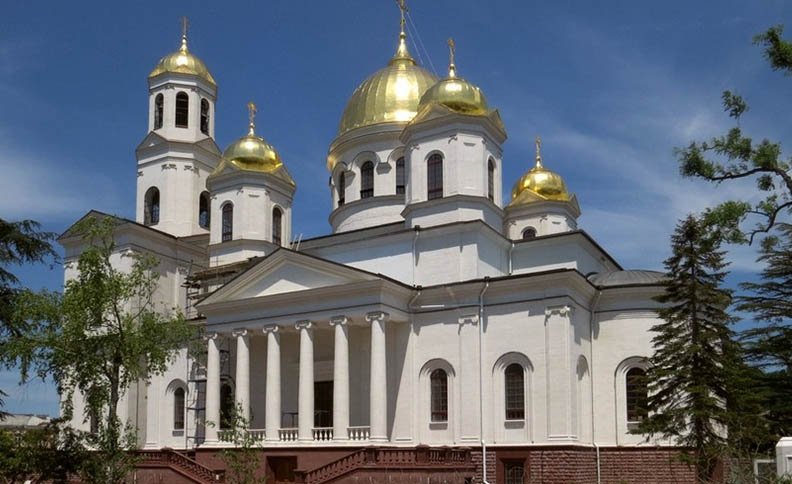
Alexander Nevsky Temple is one of the main attractions of the city of Simferopol, with a very complicated history. The temple was built for a long time, Catherine II conceived the temple, and Alexander I began to implement the construction.
Initially, the temple was built a little further. In may 1810, the Foundation stone was laid. Failed French contractors knew they had to strengthen the ground on the site of construction and build a temple. Construction progressed slowly, and later the Patriotic war of 1812 intervened. Contractors did not strengthen the ground as a result of which deep cracks formed in the walls. The Commission recognized that it is necessary to move the construction of the Temple of Alexander Nevsky to another place.
After the war of 1812, it was necessary to reduce the budget and a new project was approved. On March 12, 1823, a new Church was laid, 200 meters away from the previous construction. Completed construction in 1829 under the rule of Nicholas I. Alexander Nevsky Cathedral was one of the first monumental buildings of the new provincial city of Simferopol.
The Cathedral did not last long, just under 100 years. When the Bolsheviks came to power, on the site in 1922, they first set up a warehouse on Church property. All valuables this temple and from other churches in the city were stolen and stored here, further they removed the bells and sent them to be melted down.
On September 27, 1930, on the feast of the Exaltation of the Holy cross, the Cathedral was blown up using explosives. There had to use two sets of explosives causing two explosions, the first time the Cathedral with stood the blast, but the second explosion was tragic not only for the temple, but also for the commander who led the destruction process, he was killed by a fragment.
From the stones of the Church houses were built in Simferopol. The elders of these houses said that when the Germans bombed Simferopol, one of the bombs hit the house built with the temples stones. The house with stood the bomb and did not collapse, even though there was a huge hole in the middle. The house stands to this day, now this street is called Alexander Nevsky street.
In 1944, on the site where the Cathedral stood, in a mass grave were buried soldiers who liberated Simferopol from the Nazi occupiers. Over the grave, a T-34 tank was installed on a pedestal, and Victory square was built up. Later, the remains of the soldiers were reburied in the military cemetery, and the monument with the tank remained.
The question of restoring the Alexander Nevsky Cathedral was raised in the early 1990s. There was a long argument about the T-34 monument. As a result, it was decided to move the monument a few meters to the side, and build the Cathedral in the same original place. On January 9, 2000, the first stone was set and a capsule was laid in the Foundation of the Cathedral, construction began under the patronage of Ukrainian President Kuchma. But later the construction stopped. The first growth of trees appeared on the ruins of the construction site. Simferopol residents did not expect to see a new Church. But in 2014, after the return of Crimea to Russia, the reconstruction of the Cathedral continued under the care of President Vladimir Putin.
The Church was rebuilt in record time and now services are held here. The modern look of the Cathedral differs from the pre-revolutionary prototype. Only the style of classicism remained unchanged. In 2015, the Cathedral received a part of the relics of Saint Alexander Nevsky as a gift from the city of Saint Petersburg.
Location : Crimea
Visit the grand locations like Alexander Nevsky Temple in Simferopol and loads more that Russia has to offer!
Contact us @ Russian Info Center to Book Russia Tour
Choose from flights ex Delhi, Mumbai & Calcutta
Fill the form below and we’ll get back to you right away!